Here are games brought to you thanks to the National Oceanic and Atmospheric Administration (NOAA) National Ocean Service (NOS) and other collaborators.


Ocean Diversity Challenge

What You Will Do
Try to find all 73 ocean organisms
in the Year of the Ocean 1998 poster!

Photo credit: Courtesy Steve Shachter, NOAA

The Ocean is vital to life on earth. From the life-giving rain that nourishes crops, to life-saving medicines; from the fish that come from the ocean floor, to the goods that are transported on the sea’s surface— in some way the ocean plays a role in your life every day.

This is a poster by artist Steve Shachter, prepared for NOAA during the International Year of the Ocean (1998)[See also IYOR 2008 on Magic Porthole.] Look at the variety of living organisms!

About 275,000 marine species are known to science. But more than 95% of Earth’s oceans have not been explored, so there are almost certainly many species that are still undiscovered. Some scientists think there may be as many as ten million undiscovered species living in the ocean. Other scientists think the number may be much higher. Almost all of the major animal groups are found in the ocean, and many are not found anywhere else. So the sea holds most of Earth’s biological heritage, which scientists call biodiversity.

Why is biodiversity important? Because we know that marine organisms already provide food, fertilizer, drugs, jewellery, clothing and many other products. With so many species undiscovered, the potential for new products is huge.

Here’s a way to get acquainted with a few of the species whose home is the sea. But remember: there are millions more!

You can Find What You Will Need On NOAA Ocean Service
Go to: http://oceanservice.noaa.gov/education/for_fun/OceanDiversityChallenge.pdf


Ocean Challenge Puzzle
Ocean Explorer

Test your ocean literacy with the Ocean Challenge Puzzle! With each correct answer, you’ll reveal another tile of the puzzle. Collaborate with other users to reveal the full picture. Target: Educators, students (grades 9-12), and adults. From: fttp://oceanservice.noaa.gov/education/games.html


Make Your Own Compass

What You Will Need:
Sewing needle about one to two inches long
Small bar magnet or refrigerator magnet
A small piece of cork (corks from wine bottles work well, but not the plastic stoppers)
A small glass or cup of water to float the cork and needle
Pair of pliers


Here is a preview of what you will be creating.

What’s Happening
Magnetic fields are areas that contain a force created by moving electrical charges. Earth produces a magnetic field. This field is very weak, but it is sufficient to align magnetized objects - such as your needle - that are free to rotate. By floating the needle on the cork, you allow it to rotate freely so the needle becomes lined up with Earth’s magnetic field, and points toward the north or south pole of the planet.


Motion from the Ocean

Create your own Fish Mobile


What You Will Need

One or more copies of fish “Patterns for Fish Mobiles”
Crayons, colored markers, or colored pencils
Thin cardboard (such as from a cereal box) or poster board
Plastic lid or round piece of cardboard, at least 4 inches diameter
Yarn, string, ribbon, or fishing line, at least 10 feet
Scissors
A nail, or woodworking awl

Warnings: Be careful with the nail or awl and scissors; they are sharp


To make discoveries and solve mysteries you have to think like a fish.Video clip (Windows Media Player)

In forthcoming episodes, adventures, and games you will be taken into the intricate lives of the creatures of the coral reefs and given challenges to make discoveries such as about the symbiotic relationships between the shrimp and goby fish.

The Goby warns the shrimp, who is almost blind, of impending danger by vibrating his tail or dorsal fin. This Goby has just put up his dorsal fin as a warning; the shrimp then disappears immediately into the burrow. (Philippines, Indian Ocean). Video clip (Windows Media Player)

Why do they live together in the same hole in the sand? How do they work together to avoid predators? How do they get their food?
Coco Clownfish hides in a stinging anemone. How is she able to live among the stingers? What would happen if you touched an anemone?

Video clip 1 (Windows Media Player)

Video clip 2 (Windows Media Player)

Magicporthole™ Ecoknowledge Cards
An Exploration Feature: CEE Flash Page A Trip with Drip: The Water Drop
Brought to you by UNEP, TUNZA, and CEE (Center for Environmental Education, India) KidsRGreen program with a focus on Global Climate Change 2008.

CEE is a national institution engaged in developing programmes and material to increase awareness about the environment and sustainable development.

TUNZA is a word in Kiswahili (the common language of most East African countries) that means to "treat with care". The programme is based on a strategy that aims to provide young people with information and tools on how to "treat Mother Earth with care" and how to Act for a better world.

UNEP works in partnership with Children from all over the world. Children are represented by Junior Board which is elected every 2 years during UNEP's TUNZA International Children's Conference.
Seahorse game with images and captions about seahorses
Seahorse Game brought to you by the Birch Aquarium at Scripps

Dolphins and many other species that do not usually interact directly with coral reefs depend on the health of coral reefs for their own health. Read more about dolphins and coral reefs at (add the link) brought to you by the Wild Dolphin Project.

Play the Wild Dolphin Project game: kidspage_wordsearch.pdf

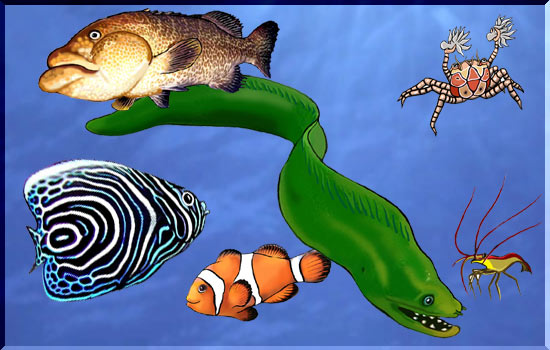
Grouper George, Boxing Barry, Coco Clown, Moray Melanie, and the Wise Old Emperor help you make discoveries as you explore coral reefs in the Magic Porthole experience.
What Is Magic Porthole™? • Wonders of Coral Reefs • Episodes & GamesIYOR • News
Ecoknowledge Cards •  ResourcesExhibit • Contests • Shop • Advisory Board • Dolphins • Credits
Census of Marine LifeContact Us